



Why Transflective Displays Don't Always Need High Backlight Brightness
Imagine using a handheld device under direct sunlight. The screen needs to remain readable, yet increasing backlight brightness can lead to higher power consumption and additional heat. When the same device moves into a shaded area or indoors, its display requirements change again.
For applications that operate across varying lighting conditions, achieving the right balance between visibility and energy efficiency is a key design challenge.Transflective display technology offers an alternative approach by combining ambient-light reflection with backlight illumination, helping maintain readability without relying entirely on a high-brightness backlight.
But how does this technology work, and why can it be a practical choice for outdoor and battery-powered devices?
1. What Makes a Transflective Display Different?
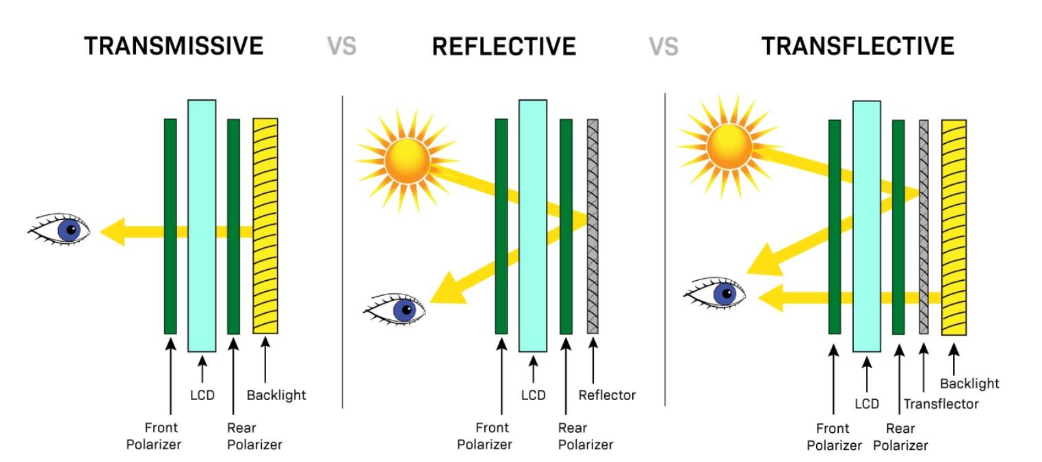
A conventional transmissive LCD relies on its backlight to illuminate the image. When ambient light becomes intense, reflections from the display surface can reduce perceived contrast, making the screen harder to read.
A transflective LCD combines two optical functions: transmission and reflection. Its partially reflective layer allows light from the backlight to pass through while reflecting a portion of the ambient light entering from the front.
This dual-mode design enables the display to use available environmental light in bright conditions and backlight illumination when ambient light is insufficient.
The key difference is that a transflective display does not rely solely on light generated by the backlight.
2. How Does Ambient Light Improve Readability?
In bright outdoor environments, sunlight provides a substantial source of illumination. A transflective display uses its reflective optical structure to direct part of this ambient light back toward the viewer.
This helps the displayed content remain visible without requiring the backlight to compete with bright surroundings on its own.
In sufficiently bright conditions, the backlight may be reduced or switched off, depending on the display design and system requirements. When the device moves indoors, enters a shaded area, or operates at night, the backlight can provide additional illumination.
This flexibility is particularly useful for equipment that moves between different lighting environments throughout the day.
3. Why Isn't a High Backlight Brightness Always Necessary?
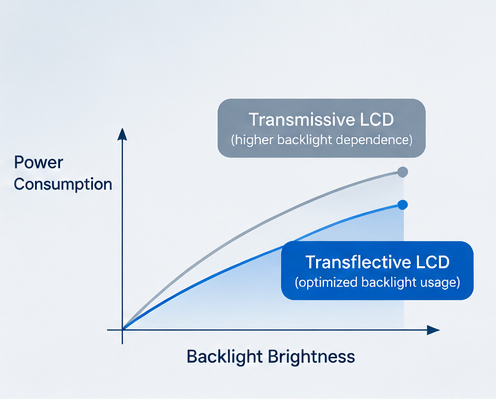
A higher-output backlight generally requires more electrical power and may generate additional heat. In battery-powered devices, these demands can shorten operating time or require a larger battery and more substantial thermal management.
Transflective displays address the challenge differently by using ambient light as part of the image-forming process.
Potential benefits include:
• Reduced backlight dependence: Ambient light can contribute to visibility in bright conditions.
• Lower power consumption: Reducing backlight output can save energy when the environment provides sufficient illumination.
• Flexible operation: Backlight illumination remains available for darker environments.
• Improved system efficiency: Display designers gain another way to balance readability, power requirements, and thermal constraints.
However, transflective technology does not automatically guarantee low power consumption in every application. Actual power savings depend on the display's optical characteristics, backlight settings, content, and operating environment.
4. Does Transflective Mean the Display Needs No Backlight?
No. This is an important distinction.
A transflective display combines reflected ambient light with transmitted backlight illumination. The reflective component supports visibility in bright environments, while the backlight helps maintain readability when ambient light levels fall.
Without sufficient ambient light, a transflective display may still require backlight illumination to achieve the desired visual performance.
The objective is not necessarily to eliminate the backlight, but to reduce unnecessary dependence on it.
For devices used both outdoors and indoors, this combination provides greater flexibility than relying exclusively on ambient light or continuous high-brightness illumination.
5. What Factors Determine the Actual Performance?
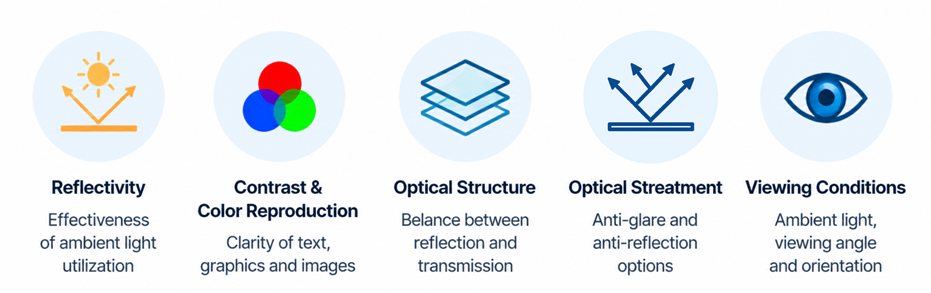
Backlight brightness is only one part of outdoor display performance. Several other factors influence how clearly a transflective display presents information.
• Reflectivity: The reflective properties of the panel influence how effectively ambient light contributes to image visibility.
• Optical structure: The balance between reflective and transmissive areas affects both daylight readability and backlight performance.
• Contrast and color reproduction: These determine how clearly text, graphics, and other information can be distinguished.
• Surface treatment: Anti-glare and anti-reflection solutions can help manage unwanted reflections, depending on the application and optical design.
• Viewing conditions: Ambient light intensity, viewing angle, display orientation, and the type of information being displayed all influence perceived readability.
For this reason, display selection should consider the complete optical system and actual operating environment rather than focusing on a single brightness specification.
6. Which Applications Benefit from Transflective Displays?
Transflective technology is particularly relevant to devices that operate across changing lighting conditions and may have limited power budgets.
Typical applications include:
• Industrial handheld terminals and portable inspection equipment
• Bicycle computers and outdoor navigation devices
• Smart transportation and vehicle-related equipment
• Marine and field-service instruments
• Portable medical and measurement devices
• Embedded industrial equipment used indoors and outdoors
For these applications, the ability to combine ambient-light utilization with backlight illumination can help engineers balance display readability, energy consumption, and system design requirements.
The most suitable solution will depend on the required color performance, resolution, touch functionality, operating temperature, and mechanical configuration.
Conclusion: A Smarter Approach to Outdoor Display Design
A display does not always need a powerful backlight to achieve good outdoor readability. By combining ambient-light reflection with backlight transmission, transflective technology offers an alternative approach to managing visibility across different lighting conditions.
For engineers developing portable and outdoor equipment, the key is to evaluate the relationship between optical performance, power consumption, and real-world usage requirements—not simply select the display with the highest brightness rating.
At Leadtek Display, our reflective and transflective display product line covers sizes from 1.5 to 28 inches, offering options for applications that require sunlight readability, low-power operation, and flexible display integration. With display solutions for industrial, transportation, medical, and portable equipment, Leadtek supports customers in selecting and customizing display modules to meet their application requirements. Explore our Transflective and Reflective Display Solutions to find a suitable starting point for your next project.


 Microsoft Teams
 WhatsApp
 Email
 Inquiry
 WeChat

 TOP